On the Queerness of Early English Drama by Tison Pugh
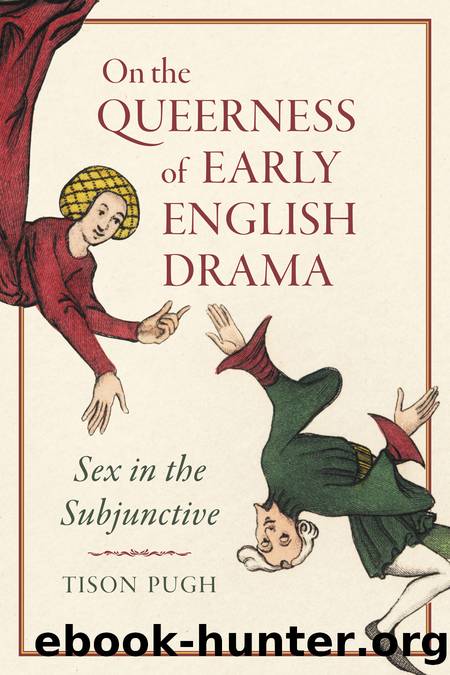
Author:Tison Pugh
Language: eng
Format: epub
Publisher: University of Toronto Press
Chapter Five
* * *
Sodomy, Chastity, and Queer Historiography in John Baleâs Interludes
A staunch advocate of the Reformation, John Bale expressed in his five extant interludes, as well as in such prose works as The Image of Both Churches, his fervent desire to cleanse England of corruption and, in particular, the sodomitical sins that he associated with the Catholic Church. Other than such figures as Alan of Lille (with his Plaint of Nature) and Peter Damian (with his Book of Gomorrah), few medieval and early modern authors so intently contemplated the spiritual and social ramifications of sodomy as did he, and so his works offer the opportunity to consider the sexual implications of the Reformation, particularly in relation to how such themes were staged in the private interludes of the Tudor era. Baleâs dramas collectively depict the spiritual horrors of sodomy as a sign of the corrupted church and its spiritual degradation from Jesusâs teachings, but in Thre Lawes of Nature, Moses, and Christ and King Johan, his recoding of England (both as a geographical landscape and as an allegorical figure) into an avatar of chastity reveals the contradictions inherent in sexual morality, especially when clerical chastity is branded as a subset of the vastly expansionary sin of sodomy. Furthermore, his effort to stage the eponymous monarch of King Johan as a representative of secular virtue undermines the distinctions that Bale attempts to erect between a fallen church and a reformed church, again owing to the impossibility of chastity signifying virtue in Reformation England. In the end, the queerness of Baleâs plays emerges not as much in their vitriolic condemnations of sodomy, or even in their staging of Sodomismus as a character in Thre Lawes of Nature, Moses, and Christ, as in the impossibility of dramatically representing both England and King John as purged of sexual sin. As Cathy Shrank proposes, Bale depicts John as âa national hero, celebrated for his stand against papal interference within Englandâs jurisdiction.â1 King Johnâs regal and English asexuality, which should serve as the corrective to papal and Roman sodomy, undermines the allegorical messages that Baleâs plays otherwise endorse. Identified as Englandâs first history play, King Johan demonstrates the ways in which allegory and historiography collide in Baleâs works, with queering repercussions for the reformerâs social and spiritual goals.
Download
This site does not store any files on its server. We only index and link to content provided by other sites. Please contact the content providers to delete copyright contents if any and email us, we'll remove relevant links or contents immediately.
| Anthropology | Archaeology |
| Philosophy | Politics & Government |
| Social Sciences | Sociology |
| Women's Studies |
Cecilia; Or, Memoirs of an Heiress — Volume 1 by Fanny Burney(32562)
The Great Music City by Andrea Baker(32023)
Cecilia; Or, Memoirs of an Heiress — Volume 2 by Fanny Burney(31959)
Cecilia; Or, Memoirs of an Heiress — Volume 3 by Fanny Burney(31945)
We're Going to Need More Wine by Gabrielle Union(19053)
All the Missing Girls by Megan Miranda(16050)
Pimp by Iceberg Slim(14522)
For the Love of Europe by Rick Steves(14174)
Bombshells: Glamour Girls of a Lifetime by Sullivan Steve(14081)
Norse Mythology by Gaiman Neil(13376)
Talking to Strangers by Malcolm Gladwell(13376)
Fifty Shades Freed by E L James(13247)
Mindhunter: Inside the FBI's Elite Serial Crime Unit by John E. Douglas & Mark Olshaker(9347)
Crazy Rich Asians by Kevin Kwan(9297)
The Lost Art of Listening by Michael P. Nichols(7509)
Enlightenment Now: The Case for Reason, Science, Humanism, and Progress by Steven Pinker(7316)
The Four Agreements by Don Miguel Ruiz(6770)
Bad Blood by John Carreyrou(6626)
Weapons of Math Destruction by Cathy O'Neil(6284)
